The short version
Copper is easy to reuse — but slow to replace
- Copper carries electricity through buildings, power grids, transport and electronics.
- The global price reflects both metal available now and what traders expect about future supply and demand.
- Copper can be recycled over and over without losing its essential properties. But collection, processing and the long working life of cables and buildings mean it does not all come back at once.
01 · The useful metal
Why copper is everywhere
A phone charger, a kettle, a train, a power line: copper is woven through ordinary life. It conducts electricity and heat well, resists corrosion, and can be drawn into wire. Those qualities make it useful in a building’s wiring and plumbing, motors, electronics and the cables that carry electricity over long distances.
The energy transition adds demand for some uses — including power grids, renewables and electric vehicles — but it is not the whole story. Construction, manufacturing and conventional electrical equipment remain major users too.[1]
02 · From rock to wire
How copper is mined
Copper begins in ore: rock that contains copper minerals. If the deposit is near the surface, miners may work downwards in a huge open pit. If it lies deeper, they reach it through shafts and tunnels. The geology determines the design — and influences the time, cost and engineering needed to get the ore out.
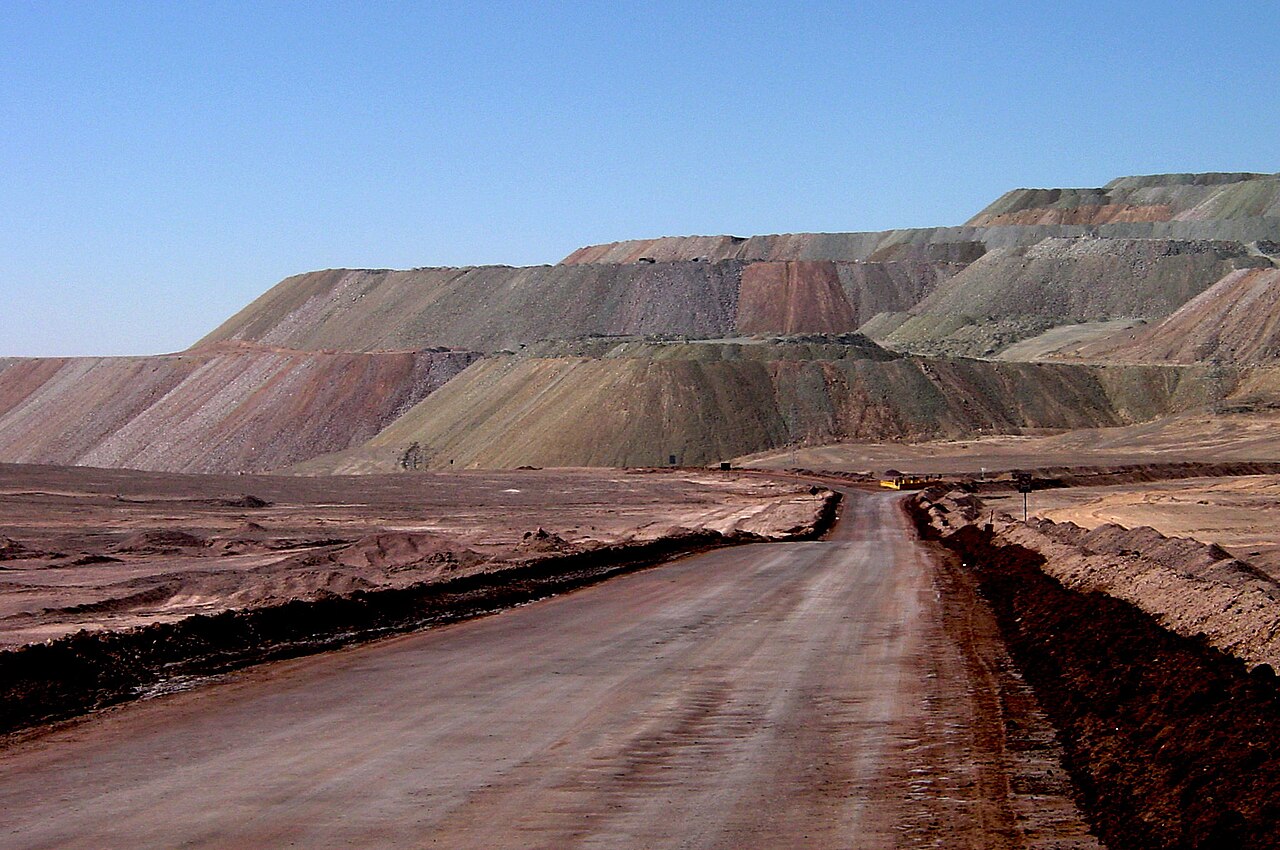
Escondida: open-pit mining
In Chile’s Atacama Desert, BHP’s Escondida operation has two open pits. BHP says ore from the pits feeds concentrator plants and leaching operations — a useful reminder that one mine can use more than one way to process its ore.[2]
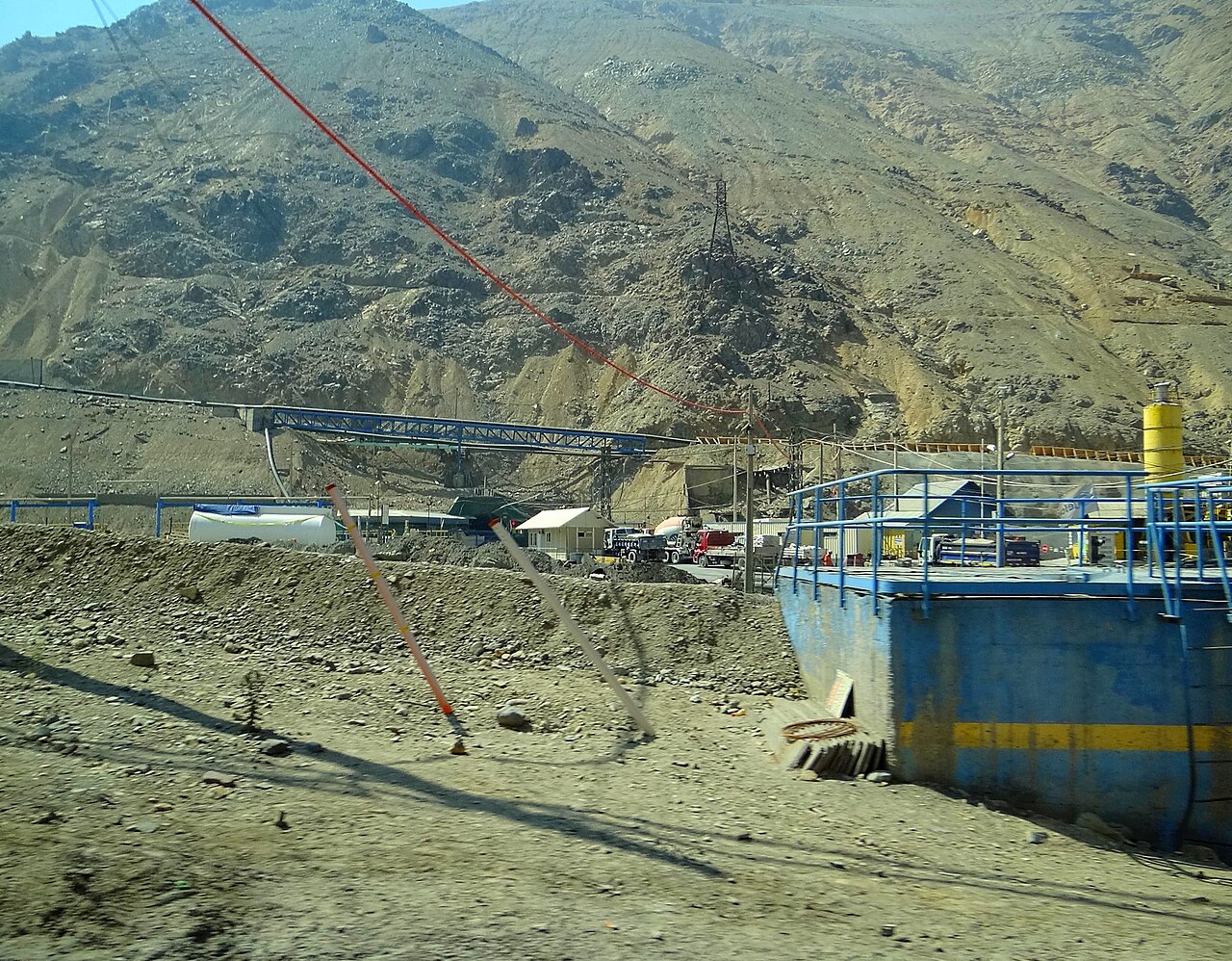
El Teniente: underground mining
Codelco’s El Teniente operation in Chile is a vast underground mine. One method used there is panel caving: miners create an opening beneath suitable ore so fractured rock breaks and falls under gravity, then collect it through underground passages. It is a specialised method for large deposits, not the way every underground mine works.[3]
What happens after the rock comes out?
The route varies with the ore, but a common path for sulphide ores looks like this:
Break out the ore
Drilling and blasting loosen rock in a pit or underground; trucks and loaders move it.
Crush and grind
Machines reduce large rocks to smaller pieces and then fine particles, freeing copper minerals from surrounding rock.
Float and concentrate
In flotation tanks, air bubbles help copper minerals rise so they can be skimmed off as a copper-rich concentrate.
Smelt and refine
Concentrate is usually smelted and refined into high-purity copper cathodes.
Or take a leaching route
For suitable ores, an acid solution dissolves copper; the metal is recovered from the solution and plated onto cathodes.
Make useful products
Refined copper is shaped into wire, sheet, pipe and other forms for manufacturers.
This is a simplified guide, not a single recipe for every mine. The US Geological Survey describes both concentration and leaching routes for copper ores.[4]
03 · Supply and demand
Why new supply takes time
A mine cannot be switched on like a tap. A discovery still needs studies, permits, finance, roads, power, water, skilled workers and community support. Expanding an existing mine can take years too. If supply is disrupted at a mine, smelter, port or transport route, replacing that metal quickly can be difficult.
Demand is broad: construction, electrical networks, manufacturing and transport all use copper. Grid upgrades, renewable power, electric vehicles and data centres add to some needs, while the global economy and technology choices can strengthen or weaken demand. The International Energy Agency tracks copper use across energy and non-energy sectors for this reason.[1]
There is also a geography problem. Copper may be mined in one country, shipped as concentrate to a smelter elsewhere, refined into metal in another place, then made into products for a fourth market. A mine and a refined-copper price are related, but they are not the same part of the chain.[5]
04 · Following the price
What moves copper prices?
The London Metal Exchange (LME) publishes benchmark copper prices used in contracts around the world.[6] Buyers and sellers use that reference, then account for the metal’s quality, location, delivery date, freight and other costs. So the benchmark is not necessarily the final price paid by a factory — and it is certainly not a shop price.
Prices also move on expectations. Traders may react to a possible mine disruption or future demand before the physical change has happened. Warehouse stocks help show what is available in certain places, but do not represent every tonne in transit or already committed to a buyer.
A little recent price context
On 30 October 2026, the LME cash-settlement benchmark was US$14,449 per metric tonne — about US$14.45 per kilogram at the benchmark level. The three-month LME price was US$14,250 a tonne.[7] Those prices are a snapshot, not a promise of what the next day will bring.
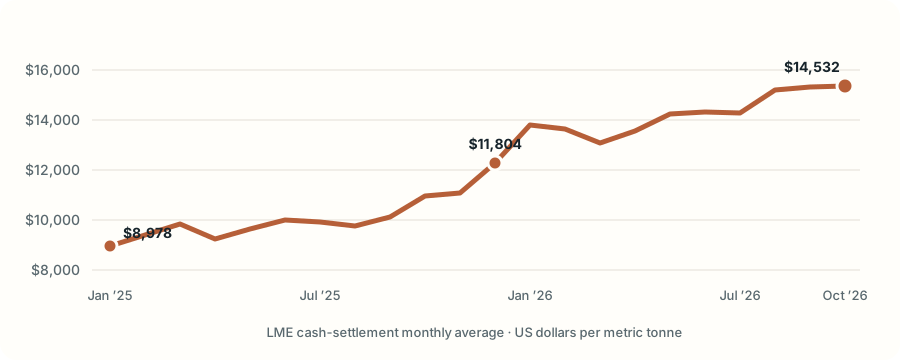
A high price does not mean it rises every month. Reuters reported that the three-month copper contract reached a then-record US$14,875 a tonne in September 2026, then was on track to fall 1.8% in October as worries about returns on heavy AI investment weighed on markets. Tightness in nearby supply remained a counter-pressure.[8] A longer-term demand story and a short-term price dip can both be true.
For a deeper look at the decade-long price story, read our copper prices, AI demand and market explainer.
05 · Scrap and recycling
Copper can be recycled again and again. Getting it back is the hard part.
Recycling does not take away copper’s essential chemical or physical properties. It can be melted and made into new products repeatedly. That is what people mean when they call copper “100% recyclable”. It does not mean every copper product is collected, every scrap stream is clean, or every bit is recovered without losses.[9]
Clean manufacturing offcuts are relatively straightforward to recycle. Old cable, electronics and mixed scrap can be harder: copper may be joined to other metals, hidden inside equipment, or difficult to separate. Collection, sorting and processing take effort, and some material is inevitably missed or lost.
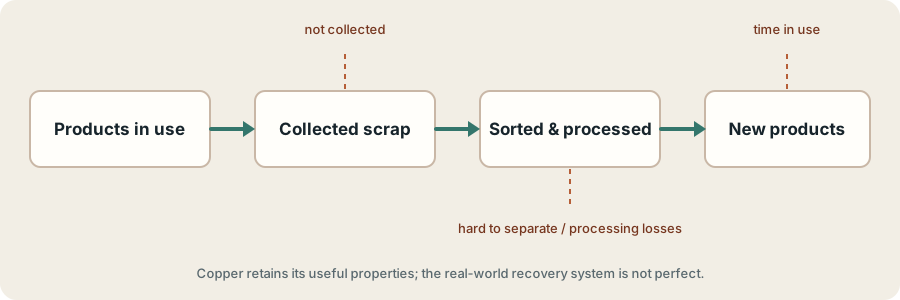
Most importantly, copper lasts. A cable or pipe can stay in service for decades. That is useful to the people relying on it, but it means the metal is not available as scrap while it is still doing its job. Recycling draws on an “urban mine” built up inside products and infrastructure over many years. It cannot instantly replace newly mined copper when demand grows faster than old material comes back.
A real-world example
BT’s old phone network: copper returning after years of use
BT’s Openreach is replacing parts of its legacy copper network as it builds full-fibre broadband. Some cables run in ducts under streets; others are on poles or inside buildings and exchanges. The recovered cable is not all the same age, and no public breakdown says how long each piece was underground.
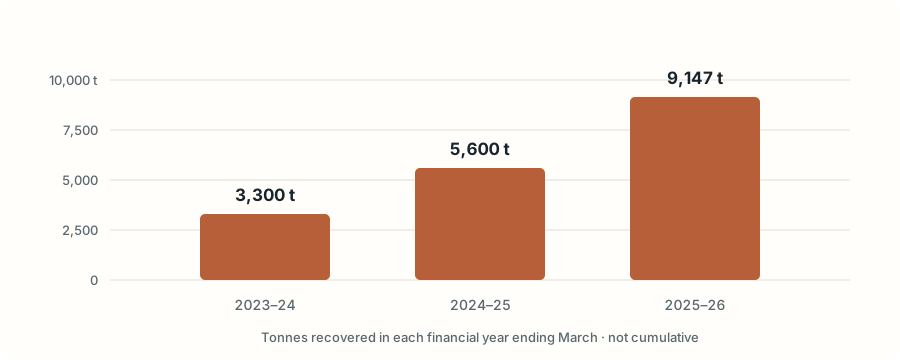
BT reported recovering 3,300 tonnes in the year to March 2024, 5,600 tonnes in 2024–25, and 9,147 tonnes in 2025–26. It had recovered 22,347 tonnes in total since the programme began in 2023. Openreach has said it could eventually recover up to 200,000 tonnes as the programme continues into the 2030s. That last figure is an estimate, not copper already collected.[10]
The agreement with recycler EMR is a route to sell copper as it is recovered during network upgrades — not a one-off job to dig up every cable. Switching off an old service and physically recovering all its cable are not the same thing.[11]
The takeaway
A durable metal — and a slow-moving market
Copper is essential to the built world. Its price reflects changing expectations about supply and demand. Recycling is powerful because the metal keeps its useful properties — but it is not an instant source. A lot of copper is still busy doing its job.
Sources and image credits
- International Energy Agency, Copper — demand scenarios and supply context.
- BHP, Escondida — open pits, concentrators and leaching operations.
- Codelco, El Teniente; Codelco on panel caving.
- U.S. Geological Survey, Mineral Commodity Summaries 2026: Copper — mining, processing and recycling background.
- International Copper Study Group, World Copper Factbook 2026 — production, trade and use.
- London Metal Exchange, LME Copper; LME Monthly Averages.
- Westmetall: 2025 and 2026 historical LME cash-settlement averages, and daily LME prices.
- Reuters, republished by Kitco, 30 October 2026 — September record and October market movement.
- International Copper Study Group, Copper Recycling.
- The Guardian, 31 August 2026 — BT’s reported copper recovery and recycling agreement.
- Openreach, “Openreach puts the stopper on copper” — network transition background.
- Photographs: Escondida by Bachelot Pierre J-P, CC BY-SA 3.0; El Teniente Adit 71 by WeHaKa, CC BY-SA 4.0. Both via Wikimedia Commons; credits and original file pages are linked under each photo.
Pricing is date-specific and shown in US dollars per metric tonne. The diagrams are explanatory; they are not live prices or production forecasts.